
How to land without the vacation bloat
The suitcase is half-packed, the linen shorts are laid out, and you're already half-dreaming about that first slow morning by the water. Then you land — and your stomach looks three months along, you haven't gone to the bathroom since you left home, and you've barely touched the bread.
I used to dread the first 48 hours of every trip for exactly this reason. I'd blame the airport food and the wine — and sure, that played a part — but the real story was happening somewhere I couldn't see.
So today I'm going to walk you through what travel actually does to your gut, and how to land feeling like yourself instead of a balloon.
Why this matters
You save the PTO. You spend the money. You wait all year for this. The last thing you want is to spend day one bloated, backed up, and doing the math on whether it was the bread or something else.
Here's the mechanism most people never hear: digestion is run by the "rest and digest" branch of your nervous system, and it only works well when you're calm. Travel does the opposite. Early alarms, security lines, tight connections, and the low-grade stress of being in motion hold you in a mild fight-or-flight state, and your body answers by pulling blood and resources away from your gut. Layer the physics of the cabin on top, and digestion doesn't slow by accident — it's been moved to the back burner. Which is why it helps to know:
Travel bloat is rarely a one-off; it's a louder version of something already simmering
"Looking bloated" and "feeling terrible" run on the same stalled system
The fix isn't restriction — it's keeping things moving
Unfortunately, most people make it worse
The instinct before a trip is to clamp down, and it backfires almost every time. People tend to:
Crash-diet or "cleanse" the week before, which slows digestion and spikes stress hormones
Rely on whatever the airport and the plane hand them, then wonder why they're inflamed
Pop a gas pill mid-flight and call it handled
None of that touches the cause. But a few specific moves will. Here's how to keep your gut calm from the gate to the beach.
Step 1: Respect your gut's clock
Your colon runs on a clock — the muscle waves that move things along peak in the morning and after meals, and nearly stop overnight. A red-eye or a few time zones desyncs that clock, so the morning contractions that should empty you out don't fire on time. Add a cabin pressurized to feel like 6,000–8,000 feet, where gut gas expands 25–30% and slow stomach emptying leaves stool sitting while your colon keeps pulling water out of it, and you've got the recipe for travel constipation. To work with the clock instead of against it:
Get up and move at least once an hour
Get sunlight on your skin as soon as you land to reset your rhythm
Keep your meals in daylight hours
Eat real meals with gaps between them — your gut runs a "cleaning wave" that only fires when you're not eating, so grazing the whole flight shuts it down
Step 2: Pack your gut a carry-on
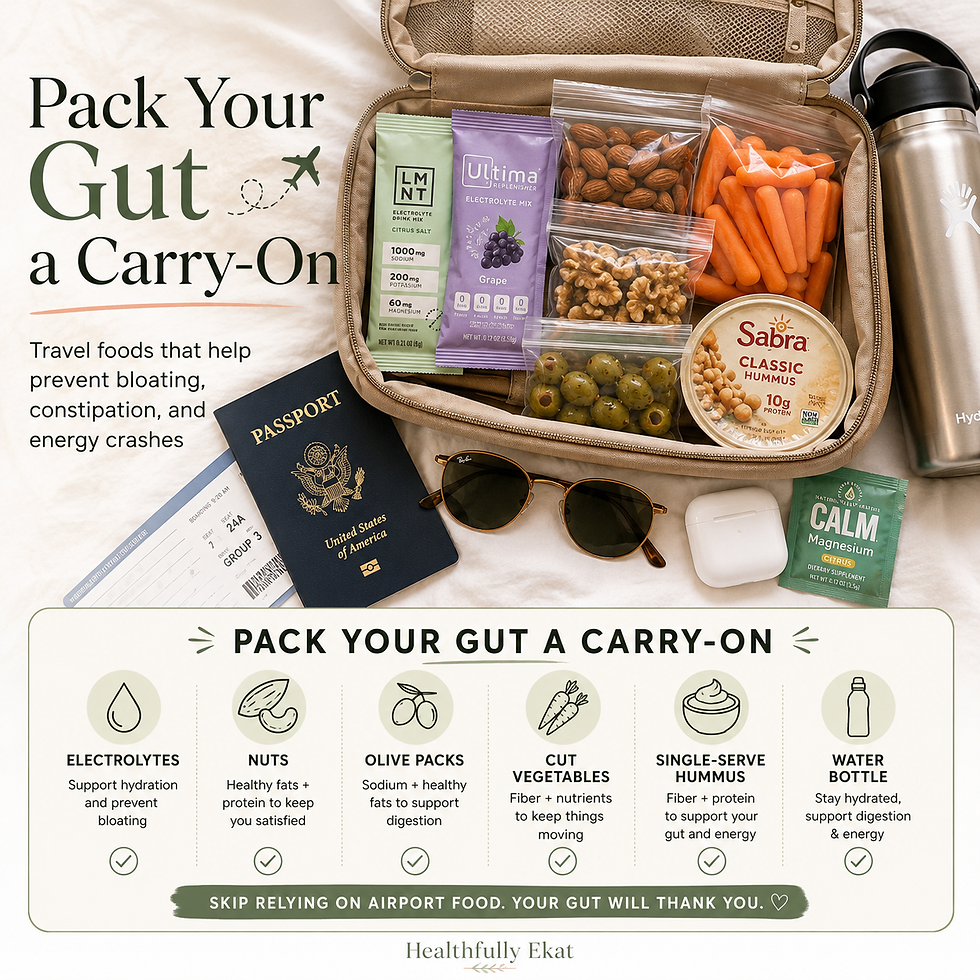
What you bring matters more than what they serve you. Build a little travel kit:
Electrolyte packets. Buying a bottle at the airport won't save you — most of it is purified water stripped of minerals, so it hydrates you far less than you think. And those minerals do more than hydrate: sodium, potassium, and magnesium are what your muscles use to contract, including the ones lining your gut wall. Run low, and motility slows right along with them.
Single-serve, real-food snacks, each in their own bag: nuts, olives, cut carrots, single-serve hummus. Easy to grab, no mystery ingredients, nothing that leaves you puffy.
Bonus points: prep your own lunch or dinner before you leave, so you know exactly what's going in instead of gambling on whatever's pressurized at 35,000 feet.
Step 3: Hydrate and breathe like it matters
The cabin air is bone-dry, and dehydration stalls digestion on its own. A little intention here goes a long way:
Drink steadily throughout the flight, with those electrolytes
Walk the aisle every chance you get to wake your gut up
Skip the straws, gum, and fizzy drinks that pump extra air into a gut that's already expanding
Before you eat, take a full minute of slow nasal breathing — it shifts you out of travel-stress mode and into the calm state your gut needs to actually break down the meal
Do even half of this and you'll:
Step off the plane regular, not backed up
Wear what you packed on day one without the internal debate
Actually taste the food instead of fearing it
The bottom line
Here's the principle worth carrying off the plane: bloating and constipation are common, but common isn't the same as normal. They're information. If you run all of this and still puff up every single trip — or every few days at home — your gut isn't broken, it's communicating. Travel simply turns up the volume on what your digestion was already working around: how completely you break down food, the makeup of your microbiome, the low-grade inflammation you can't see from the outside.
The only way to answer those questions is to look instead of guess, which is the entire reason functional stool testing exists, and what my Bloat Fix program is built around. But that's a conversation for when you're back and unpacked.
For now, pack the electrolytes, space your meals, and walk the aisle. Then tell me where you're headed this summer — I love living vicariously through a good itinerary.
Disclaimer: This post is intended for inspirational and informational purposes only, is not a substitute for medical advice, and is not intended to diagnose, treat, prevent, or cure any disease. Consult with your healthcare provider before making any changes to your routine.
References:
Hoogerwerf R, et al. Disruption of Circadian Rhythms and Gut Motility. Journal of Clinical Gastroenterology. 2020.
Rosenberg J, et al. Flatulence on Airplanes: Just Let it Go. New Zealand Medical Journal.


